Which of the Following Is an Effective Therapeutic Communication
The medical assistant communicates nonverbally using tone of voice and facial gestures. Open-ended statements and questions are often used.
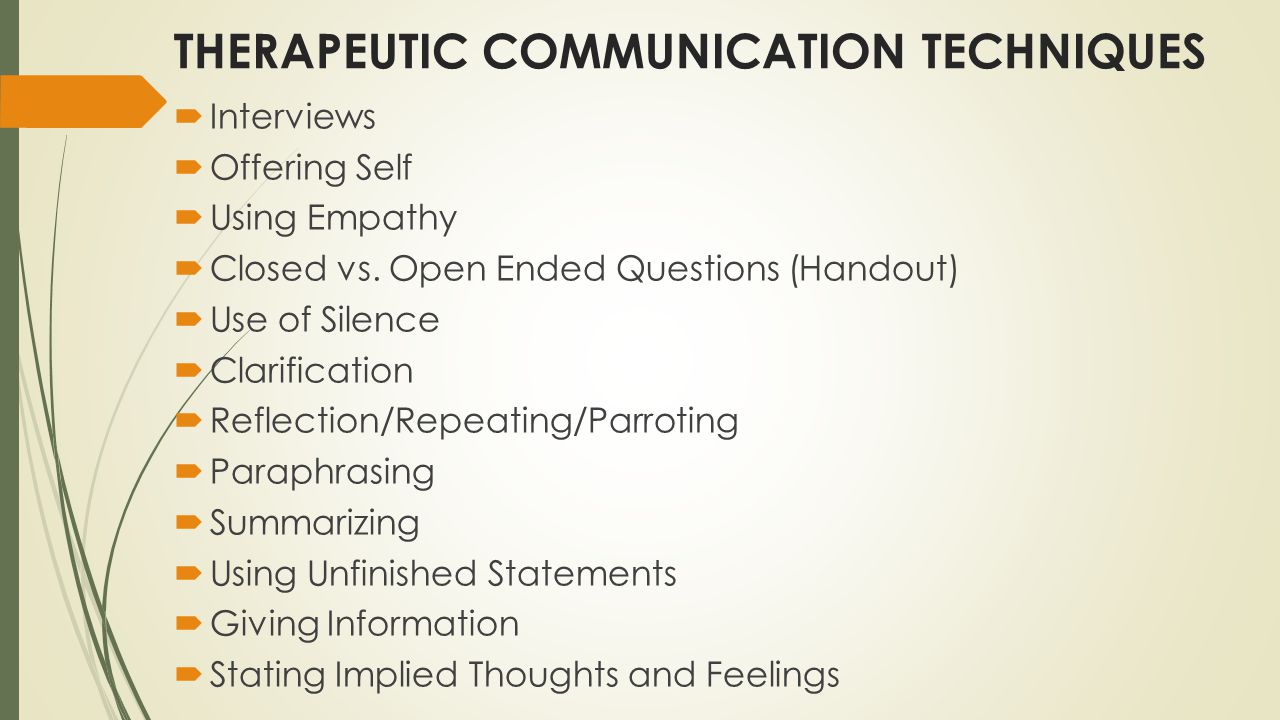
Therapeutic Communication Ppt Download
1 encourage the client to speak.
. Examples of effective therapeutic communication techniques making observations being silent and accepting which of the following relate to facial expression eye contact posture touch and attention to personal space. Responding to the patient in a defensive manner When a medical assistant is in a heated argument with a coworker and she directs the conversation toward clarifying the problem she is said to be using which of the following communication. Therapeutic communication is a reciprocal interaction based on trust and aimed at identifying patient needs and developing mutual goals.
Allow the patient time to think and gain insight 4. Two of the earliest reported cases of therapeutic communication which primarily involved the idea of the therapeutic relationship and the benefits of such a relationship were documented during the moral treatment era of. Recognizing the impact of communication on others.
Specific and well-defined professional skills are required There is no influence by personal feelings of self It takes place only in verbal communication It does not change with culture. Therapeutic communication is the assessment component of the nursing process. Giving approval Body language includes facial expressions eye contact posture attention to.
NR341 Complex Adult Health RUA Interdisciplinary Management of Healthcare Technology Guidelines. You are assessing a 75 yr old with mild shortness of breath. Prompt the patient to talk when he or she is ready 3.
As you are asking questions regarding her chief complaint and medical history you progressively move closer to her. This purpose of this assignment is for the student to present a complete picture of interdisciplinary care using specific therapeutic modalities in the care of a complex adult health client. Which of the following is true about therapeutic communication.
In therapeutic communication there is a verbal and non-verbal flow of information between nurses and patients 3. In this scenario it is important to. Select all that apply 1.
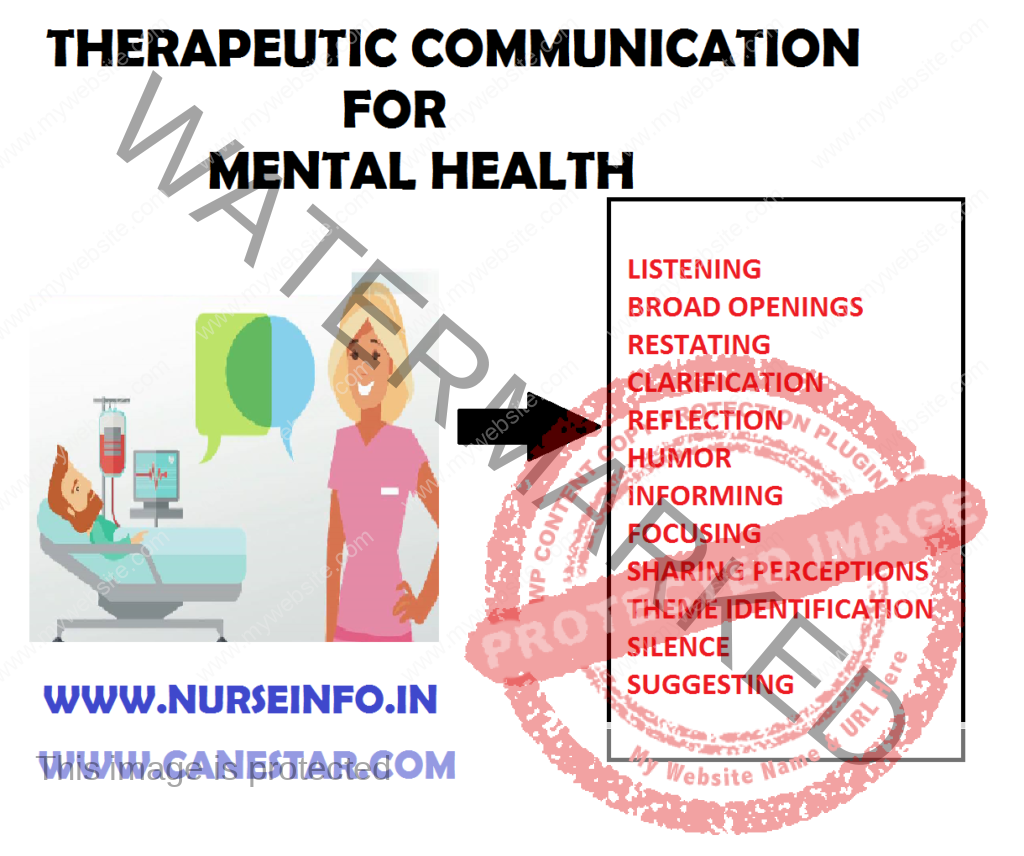
Therapeutic communication as a concept emerged early in medicine and has since shown significant benefits borne out in research. Therapeutic communication techniques include listening maintaining silence maintaining neutral responses using broad openings and open-ended questions focusing and refocusing restating clarifying and validating sharing perceptions reflecting providing acknowledgment and feedback giving information presenting reality encouraging formulation of a plan of action. Open questions encourage a patient to explain symptoms in his or her own way.
Silence is an effective technique to encourage a patient to continue speaking. A closed question expects a yesno or very short answer. Implementing barriers to effective communication.
Which of the following is an example of an ineffective therapeutic communication. Specific techniques in therapeutic nursing include giving supportive remarks providing rewards or gestures of approval and offering their presence according to Effective Communication in. Allow time for the patient to drift off to sleep 5.
This connection demonstrates the. Nurses are meant to provide patients with that support and information while they are maintaining a professional distance and objectivity. Prevent the nurse from saying the wrong thing 2.
Therapeutic communication conveys feelings of warmth acceptance and empathy from the nurse to a patient in a relaxed atmosphere. Using statements or questions that. Therapeutic communication techniques Providing general leads.
Effective therapeutic communication is a way to improve nurse-patient interaction as well as build trust between the registered nurse and their patients. Silence is a therapeutic communication technique that is also very helpful when the nurse wants to give the client ample time to fully and openly discuss their feelings opinions and beliefs however prolonged silence may be interpreted by the client as a lack of interest on the part of the nurse so silence in order to remain therapeutic must be of an appropriate. Examples of effective therapeutic communication Ways to use non-verbal therapeutic communication Skills Practiced.
Verbal and nonverbal communication techniques. The verbal aspect of communication employs the use of words whilst non-verbal communication makes use of non-verbal cues such as eye contact body language and facial expression 3. Within the healthcare the importance of the establishment of fostering the effective therapeutic relationship in between the nurse and patient which can be done through the verbal soft-spoken skills using appropriate tones attitudes behavior and using good words and the nonverbal skills like touching eyes and facial behavior which nursing staff and patients can interact with.
Ensuring that verbal and non-verbal messages are incongruent. What is the purpose of the nurses silence. Facial movements connect with words to illustrate meaning.
30 rows Therapeutic communication also involves nonverbal communication is behavior that a person exhibits while delivering verbal content. The nurse uses silence as a therapeutic communication technique. The student will demonstrate clinical.
Accepting pauses or silences that may extend for several seconds or minutes without interjecting any verbal response. Terms in this set 25 Effective therapeutic communication skills require ___. Actively listening with good-eye contact.
All of the following are effective communication strategies for dealing with difficult patients EXCEPT. The human face produces the most visible complex and sometimes confusing nonverbal messages.

Therapeutic And Non Therapeuitc Communication Techniques

Therapeutic Communication Ppt Download
Therapeutic Communication Principles Or Characteristics Techniques And Non Therapeutic Communication Nurseinfo


Comments
Post a Comment